A new research paper from ARK Invest and Unchained examines one of Bitcoin’s most persistent questions: whether advances in quantum computing could eventually break its cryptography.
The authors conclude that while the technology represents a legitimate long-term concern, it does not pose an immediate threat to the network. Published on March 11 and written by Dhruv Bansal, Tom Honzik and David Puell, the report argues that current quantum systems remain far from the power needed to break down Bitcoin’s cryptographic foundations.
The Bitcoin Quantum Threat Is Far, Not Immediate
The central thesis of the paper is straightforward: quantum computing represents a real but slow risk.
“Our two main arguments are as follows,” the authors wrote. “Quantum is a long-term threat but not an imminent threat. The public must continue to research and develop plans to protect the network as quantum computers develop.”
They add that even if there is success, exploiting it against Bitcoin will be expensive and slow. “If quantum computing were to affect Bitcoin’s cryptography, the process would be drawn out and done at a reasonable cost to the attacker.”
In practical terms, the report notes that today’s machines fall far short of the scale required to attack the elliptic-curve cryptography used by Bitcoin keys. Current devices operate in what researchers call the “NISQ era,” characterized by limited logic qubits and high error rates.
Breaking Bitcoin’s cryptography will require very advanced systems. “To do that would require at least 2,330 logical qubits and tens of millions to millions of quantum gates,” the authors write, far beyond the 100-qubit systems common today.
Instead of a sudden technological shock, this paper shows a systematic progression towards any significant threat. The authors describe a series of important steps in quantum development. Early stages include experimental systems with limited commercial utility. Later stages will see applications in fields such as chemistry or materials science long before cryptographic attacks become effective.
Only at the most advanced stages can quantum computers break the elliptic-curve cryptography – and even then the process may take longer than Bitcoin’s block interval of about 10 minutes.
The researchers stress that this gradual progression will cause many warning signs. “In our view, quantum development will be a gradual technological advance – not a ‘Q-day’ event – that gives the markets and the Bitcoin network time to adapt.”
The implication is that the broader internet security ecosystem may face disruption before Bitcoin is particularly vulnerable. The paper says: “A meaningful breakthrough could disrupt Internet security first, prompting collective responses beyond Bitcoin.”
The report also estimates how much bitcoin could be at risk if a massive quantum attack were to occur. According to the analysis, about 1.7 million BTC stored in old P2PK addresses are considered exposed but may be lost. Another 5.2 million BTC resides in address formats that can be moved if necessary.
Taken together, the authors estimate that about 35% of the remaining total can be affected by quantum exposure in its current form. However, because many of those letters don’t work or can be delivered to secure address ranges, researchers are classifying the issue as manageable rather than catastrophic.
Governance and Development Remain Open Questions
While the technological threat is far from over, the report highlights the management challenges that may arise if the ecosystem eventually needs to use post-quantum cryptography. Improving Bitcoin’s cryptographic primitives will require consensus changes, which means cooperation among all developers, miners, node operators, and the wider community.
The authors also raise unsolved questions about coins whose public keys have already been exposed on the chain. “There is no consensus on how to protect coins that remain quantum vulnerable,” the report notes, pointing to ongoing debates about whether these coins should be ported, banned, or treated as discoverable by quantum attackers.
The researchers eventually framed the issue as a long-range engineering problem rather than an imminent danger. “The quantum risk will emerge over a long period of time, with many intermediate warning signs and decisions,” the authors conclude. “One point of failure is impossible.”
At press time, Bitcoin traded at $69,496.
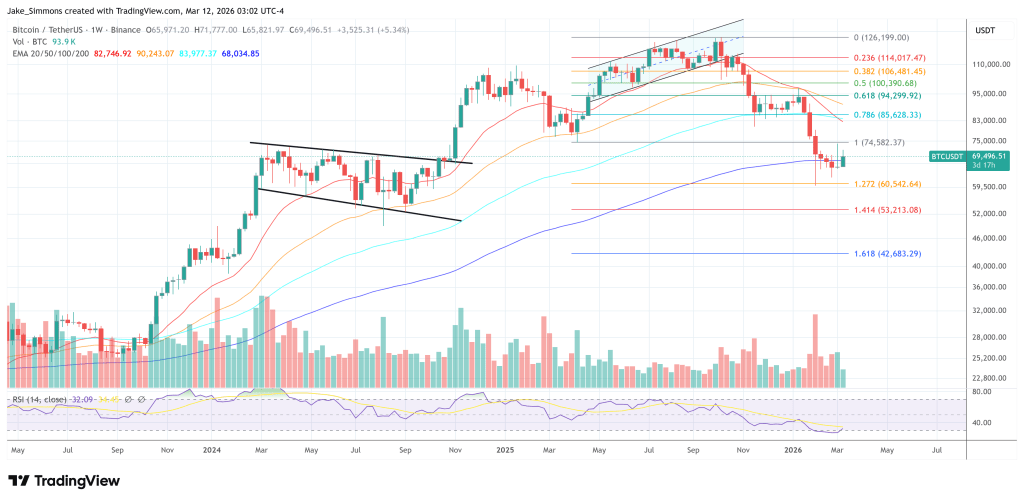
The featured image was created with DALL.E, a chart from TradingView.com

Planning process because bitcoinist focuses on delivering well-researched, accurate, and unbiased content. We maintain strict sourcing standards, and each page is diligently reviewed by our team of senior technical experts and experienced editors. This process ensures the integrity, relevance, and value of our content to our readers.