A new conflict between XRP critics and defenders erupted on X after Chainlink Community Liaison Zach Rynes (@ChainLinkGod) argued that XRP’s investment thesis failed to keep pace with how crypto markets and financial infrastructure have evolved. His central claim was absurd: the XRP Ledger is now a “ghost chain,” and the use case once placed on XRP as a bridge asset has been largely overtaken by stablecoins and broader interoperability infrastructure.
Rynes builds an argument on what he calls the long-term sell-off thesis behind XRP. “The strange selling thesis of XRP is that it will become a globally traded reserve currency, the so-called ‘XRP standard,'” he wrote. “Instead of trading Dollars for Euros directly, you will trade USD for XRP, then trade XRP for EUR, because this makes the payments more efficient.”
He pointed out that XRP fans prefer to describe this not as a bid for the reserve currency, but as a small role of “bridge money”. In his view, that difference does not change the argument. He said the biggest problem is that the market structure envisioned by early XRP advocates has been built in other ways over the past decade.
“The idea of XRP was created ten years ago before we had modern 200K TPS chains, programmable smart contracts, DeFi protocols, fiat-backed stablecoins, tokenized deposits, DvP/PvP atomic swaps, and cross-chain infra,” Rynes wrote. “If you listen to what the world’s largest financial institutions and market infrastructure such as Swift, DTCC, JP Morgan, BlackRock, and many others have to say, you will find that there is no mention of the need for ‘bridge capital.’ Instead, they talk about the need for communication, collaboration, privacy, compliance, and orchestration.”
That criticism extended to the XRP Ledger’s role in tokens and on-chain finance. Rynes said that XRPL “will be the leading chain of real assets of the token world” remains a popular belief among XRP holders despite what he described as weak adoption metrics. He called XRPL a “ghost chain with less than 1% RWA market share and less than 0.01% of stablecoins,” arguing that this makes the idea of XRPL’s emergence as a core layer difficult to defend.
He also identified stablecoins as a viable winner in the bridge-asset debate. According to Rynes, “USD-backed stablecoins have become the ‘bridge currency’ of crypto-native” payments, trading, and finance,” and the industry has already built “everything XRP should be, except XRP.” He cited Hyperliquid as an example of crypto-native currencies where positions in all markets are successfully made against dollar-backed stablecoins rather than XRP.
The second part of his argument focused less on the ledger design and more on Ripple’s business model. Rynes alleges that Ripple is “combining its costs to XRP holders and privatizing the benefits to its shareholders,” saying that the XRP trading products of the wallet generate revenue from Ripple rather than directly from token holders. He makes the same point about RLUSD, writing that about 90% of its supply resides in Ethereum and other chains, which in his opinion creates little direct demand for XRP itself.
The XRP Community Fires Back
Not everyone in the series accepted that frame. XRP attorney and attorney Bill Morgan debunked Rynes’ comparison between token purchases and share purchases, calling it a “false equivalence because a token is not the same as a share and does not have the rights attached to it as a share.” He also rejected the idea that Ripple and XRPL should be considered the same thing, writing that “Ripple does not own XRPL which is a completely decentralized blockchain with no public permission.”
Morgan argued that Ripple chose a different structure with Evernorth, which he described as a private vehicle designed to acquire XRP and provide institutions with controlled exposure. He said that model was better than Ripple itself running a repository that could attract regulatory scrutiny, especially if the SEC previously identified Ripple’s efforts to prop up the price of XRP in the case.
At press time, XRP traded at $1.4757.
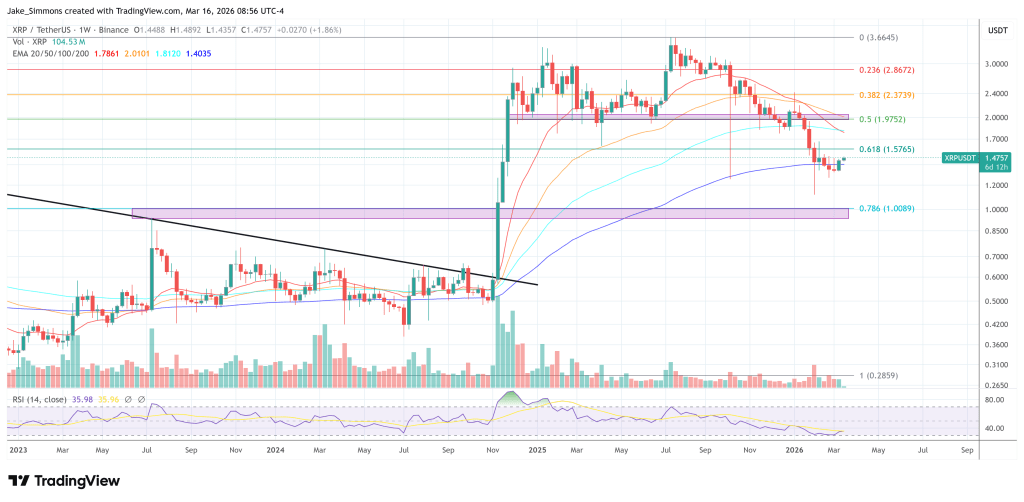
The featured image was created with DALL.E, a chart from TradingView.com

Planning process because bitcoinist focuses on delivering well-researched, accurate, and unbiased content. We maintain strict sourcing standards, and each page is diligently reviewed by our team of senior technical experts and experienced editors. This process ensures the integrity, relevance, and value of our content to our readers.