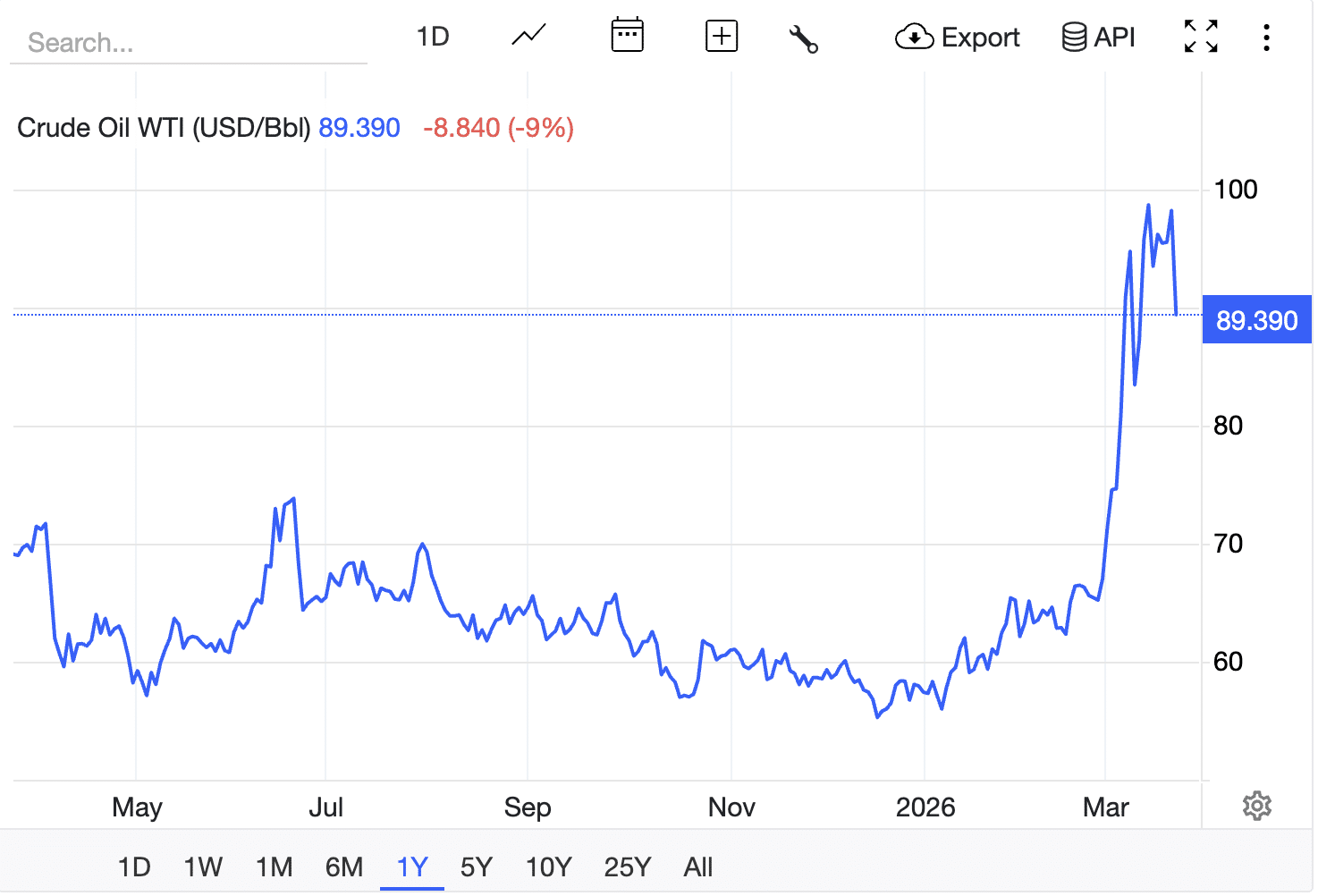
While global markets are reeling from rising Oil Prices and tensions in the Middle East, Bitcoin is doing something unexpected. Typically, when crude oil rises above $100 per barrel, risk assets such as technology stocks and cryptocurrencies sell off heavily as fear grips the market.
However, as the Strait of Hormuz, a choke point for nearly 20% of the world’s daily oil supply, remains effectively blocked by military action, Bitcoin has caught on.
Bitcoin just dropped $2,000 in the last 30 minutes and finished $232,000,000 in crypto longs.
This happened after President Trump threatened to "destroy" Iran’s power plants if they do not open the Strait of Hormuz within 48 hours.
Yesterday President Trump said he… pic.twitter.com/iRd4jurV4Q
— Bull Theory (@BullTheoryio) March 22, 2026
This divergence has also fueled the ‘digital gold’ thesis among institutional investors. Instead of trading like a volatile technology stock, Bitcoin is starting to behave like a borderless hedge against chaos.
The question for your portfolio is simple: Is this a temporary blip, or has the market finally accepted Bitcoin as a true store of value in times of crisis?
Why Rising Oil Prices Cause Bitcoin USD Pump?
(SOURCE: TradingEconomics)
To understand why the crisis in the Persian Gulf affects blockchain prices, consider how inflation is transmitted. When the Strait of Hormuz is blocked, the cost of energy goes up, leading to an increase in oil prices. Since oil is essential for many goods, this causes inflation which reduces costs.
In general, inflation prompts the Federal Reserve to raise interest rates, raise interest rates and affect speculative assets. However, high oil prices present risks that fiat currencies are difficult to manage. When central banks print money to cover rising energy costs, the purchasing power of currencies such as the dollar, euro, and yen declines.
This is where the Inflation Hedge narrative of Bitcoin comes into play. With a limited supply of 21 million coins, Bitcoin USD cannot be printed by major banks. As reliance on fiat currencies weakens amid global risks, investors are turning to Bitcoin as a stable asset, just as gold was historically viewed.
Divergent Signal: Bitcoin vs. S&P 500
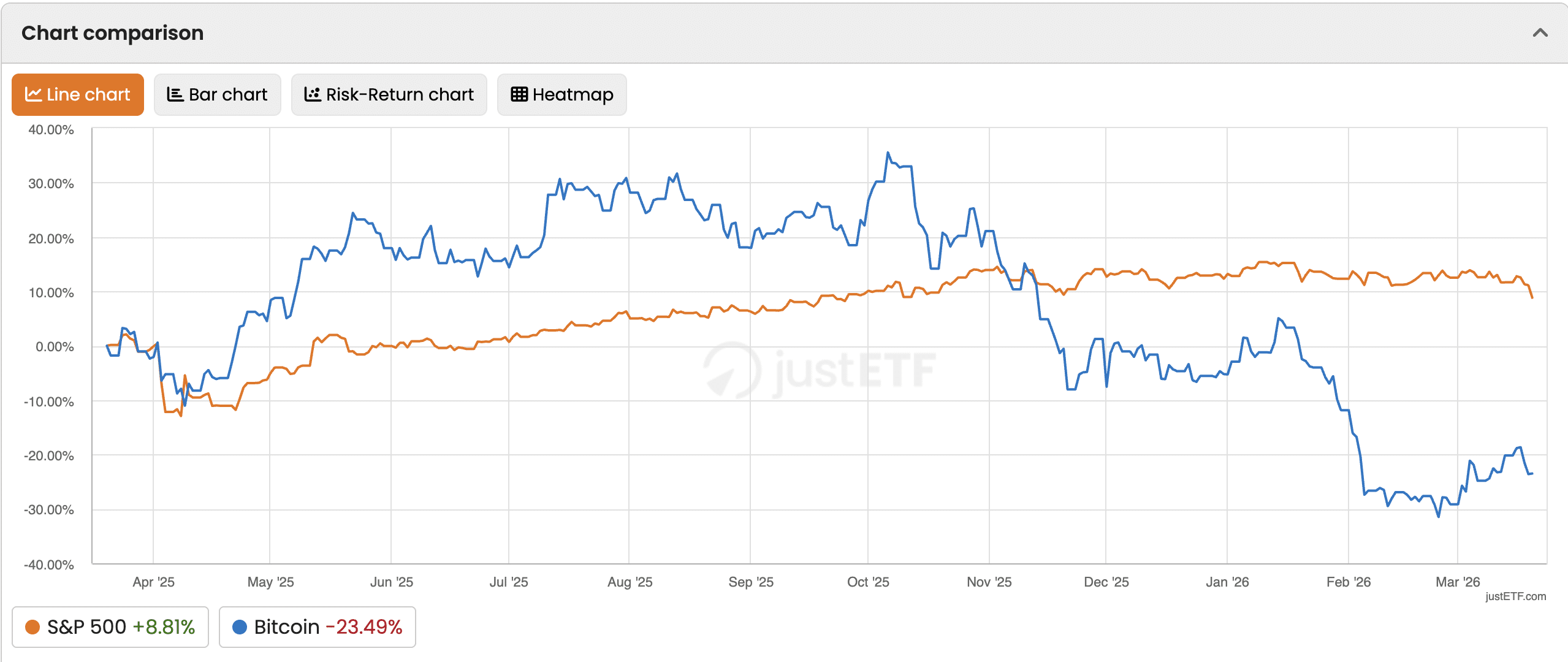
(SOURCE: justetf.com)
The most telling signal at the moment is the divergence between Bitcoin and the S&P 500. For most of the last decade, Bitcoin has outperformed the stock market. When stocks get dumped, crypto loses more. But since the February 28 surge began disrupting LNG and crude flows, we’re seeing a rift.
While the S&P 500 is struggling under the weight of uncertain energy costs, Bitcoin price action is showing resilience near key support levels. This suggests that capital does not simply abandon risky assets; it moves around in safe places. The pivot of the store value narrative is important here. If capital managers view BTC as a hedge rather than a risk, the buying pressure becomes structural rather than speculative.
Matt Hougan, Chief Investment Officer at Bitwise, has often noted that for Bitcoin to mature, it must be boring in the face of panic. We are now seeing the first signs of this growth. Spot Bitcoin ETF inflows remain positive as traditional energy sector ETFs experience significant volatility. Retail investors may panic, but the data suggests that institutions are using this dip to accumulate.
GET: The Next 1000 Crypto Gem before It Lists on Exchange
The Bull and Bear Case for Bitcoin USD: The Ultimate Geopolitical Hedge
$BTC it has been crushing gold and silver since US-Iran started.
BTC/Gold: + 28.34%
BTC/Silver: +50.46%Bitcoin is security when it matters most. pic.twitter.com/WTtR4KCs9t
– Max Crypto (@MaxCrypto) March 23, 2026
Bitcoin’s bull case during the Strait of Hormuz crisis hinged on its resistance to censorship. Financial sanctions are often accompanied by military conflicts, making decentralized assets more valuable.
If oil prices stay above $100/barrel, Bitcoin could flourish as “digital gold.” Unlike gold, which is heavy and often held, Bitcoin is weightless and easily transferred. An increase in the demand for private capital is related to the intensity of conflicts.
If Bitcoin’s correlation with gold strengthens while that with stocks weakens, it could surpass $80,000, driven by demand for neutral reserves.
Accidents continue. The bear case suggests that the ‘digital gold’ narrative may not be true. A significant increase in oil prices, say to $130 or $150, would lead to demand destruction, freeze the world economy, and dry up the deficit.
In such cases, investors tend to sell their liquid assets, such as Bitcoin, which can be sold quickly. This was seen in March 2020 when the panic caused everything to crash, including gold and Bitcoin.
If the Federal Reserve implements an oil-driven anti-inflation strategy, higher real yields could have a negative impact on non-yielding assets like Bitcoin. Failure to hold the $60,000 support level would indicate that the market considers crypto a more dangerous luxury than a necessity.
CHECK OUT: Top Crypto Presales to Watch Now
Follow 99Bitcoins on X (Twitter) For the latest market updates and subscribe to YouTube For Daily Expert Market Analysis.
The post Oil at $100+ and ‘Digital Gold’ Vision: Investors Flock to Bitcoin USD appeared first on 99Bitcoins.