
NYDIG says STRC’s fast-growing Strategy issuance has become a logical new source of growing demand for bitcoin, but says the structure is not widely understood. In a March 20 research note, the company said the popular stock complex surrounding Strategy and similar vehicles like Strive’s SATA should be viewed less as traditional corporate debt and more as a managed, bitcoin-backed debt program whose viability depends on capital market access and investor confidence.
That distinction is important because Strategy’s recent bitcoin purchases have largely been funded through preferred equity rather than through instruments most investors would normally associate with the company. According to the NYDIG, Isu issued nearly $1.2 billion in STRC last week alone, bringing the total STRC balance to just over $5 billion. Combined with another $5 billion in preferred equity, the company’s total preferred stock now exceeds $10 billion and has surpassed the convertible debt on its capital structure.
NYDIG Breaks the Bitcoin Flywheel
NYDIG’s main point is that STRC and SATA “are not well understood through the lens of common credit or equity.” Instead, the company wrote, “they are best viewed as actively managed credit structures, dependent on capital markets backed by the underlying asset, bitcoin.” That framework applies to every note.
The report says these securities are very different from conventional debt. They are low in debt but high in equity, unsecured, and come with flexible, fully discretionary shares and limited governance rights. Most importantly, NYDIG says that issuers are actively trying to keep them trading close, usually around $100, by signing, managing shares and making periodic adjustments to share levels.
From NYDIG’s point of view, that means the real limit is not working cash flow. “These instruments are not capital-funded, and are not designed to be used for corporate income,” the company wrote. “Instead, they act as capital market vehicles where preferred securities are the primary funding product, and the corporate balance sheet, comprised of bitcoin holdings, is built to support ongoing issuance.” In that context, traditional metrics like EBIT-to-interest coverage are not the right tool to judge sustainability.
The note also rejects the idea that bitcoin’s decline will automatically force the liquidation of the entire structure. Strategy debt, NYDIG said, is generally unsecured and has limited financial covenants unless otherwise expressly stated. Defaults are “primarily caused by default or bankruptcy, not market-to-market declines in asset prices,” and that logic extends in important ways to the preferred layer as well. There are no strong causes tied directly to bitcoin price movements or coverage ratios, although preferred owners remain highly exposed to management discretion and subjectivity risk.
That leads to the “flywheel” at the heart of the report. If the likes of STRC and SATA trade close, issuers can raise capital accordingly. That money is used to buy bitcoin, expand the asset base and, according to NYDIG, strengthen the balance sheet. If common equity also trades above NAV, stock issuance is acceptable on a bitcoin-per-share basis, which reinforces the cycle.
NYDIG describes it as a dynamic loop in which “money accesses capital bitcoin to buy, which strengthens the balance sheet and strengthens the confidence of investors, which allows continuous issuance.” But it also emphasizes that the machine is conditional rather than permanent. “As long as preferences remain close, equity trades above NAV, and capital markets remain open, the flywheel drives continued demand for bitcoin,” the report said.
The opposite is also true. If bitcoin falls, confidence weakens, or the preference falls below, issuance becomes difficult or non-economic. That would stop the system without needing to pay taxes. NYDIG states that the burden of adjustment then shifts to the preferred category through assignment reversals, rate changes or deeper subordination as new claims are added.
The company even frames STRC through an options lens, saying it’s similar to a shorted bitcoin investment, with the yield gained in exchange for lower risk if bitcoin weakens and erodes the asset’s cushion. But unlike the traditional option, there is no fixed strike or growth, and the results are highly dependent on the management’s decisions.
At press time, BTC traded at $70,885.
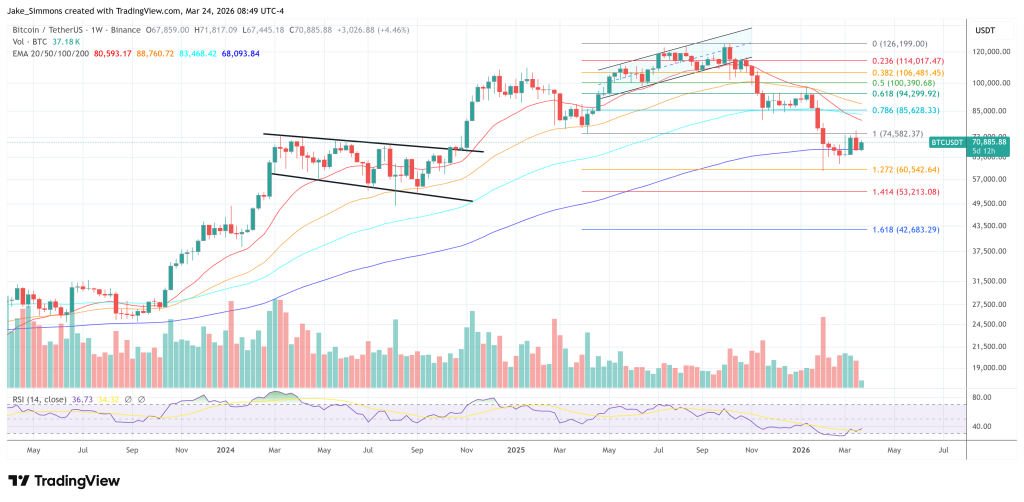
The featured image was created with DALL.E, a chart from TradingView.com

Planning process because bitcoinist focuses on delivering well-researched, accurate, and unbiased content. We maintain strict sourcing standards, and each page is diligently reviewed by our team of senior technical experts and experienced editors. This process ensures the integrity, relevance, and value of our content to our readers.