openJiuwen Community Releases ‘JiuwenClaw’: A Self Evolving AI Agent for Task Management

Over the past year, AI agents have evolved from answering questions to trying to perform real tasks. However, an important barrier has emerged: while many agents may seem smart during a conversation, they often ‘drop the ball’ when it comes to performing real-world tasks.
Whether it’s an office workflow that breaks when needs change, or a content creation job that feels like starting from scratch with every plan, the problem isn’t a lack of model intelligence—it’s a lack of consistent ability to execute.
Recently, the openJiuwen community released the JiuwenClaw. It is not intended to be a “chatty” agent; instead, it focuses on a more important question: Can an AI agent take a job from start to finish?
I. Time Flow for AI Agents: Who Can Really Complete Complex Tasks?
1. Dynamic Office Scenarios: Adapting to Change, Not Just Steps
In a typical Excel task, the user might start by editing a table, then suddenly ask to remove duplicates, then add a summary, and finally change the output format. Traditional agents often treat every change as a new, abstract and repetitive task.
JiuwenClaw acts as a true “executor”:
- It supports job interruptions, insertions, rearrangements, and deletions.
- Maintains focus on goal despite changes.
- It provides a visible, manageable, and configurable workflow.
This is in line with its first core competence: IIntelligent Task Planning: Not just breaking down steps but continuously managing task status and priorities.
When faced with complex inputs—work additions, interruptions, changes—JiuwenClaw accurately understands objectives, plans wisely, and completes every objective in a timely manner.
2. Content Creation: Overcoming the Challenge of Iterative Filtering
In real-world content creation, the workflow is iterative in nature—including brainstorming, tonal adjustments, layout redesigns, and localized rewrites. The main failure mode of traditional agents is Contextual Amnesia: with every small edit, the agent successfully “resets the session”, losing the subtle nuances of the previous draft.
JiuwenClaw disrupts this pattern by maintaining the integrity of multiple layers of content:
- Understanding Sub-Editing: Identifies which specific layer (texture vs. tone) is being edited.
- Preservation of Style and Composition: Maintains consistency between multiple iterations.
- Continuous Development: Builds upon existing drafts instead of producing from scratch.
This seamless experience is powered by the synergy of two architectural innovations:
(1) Categorical Memory System
The three-layer structure (stable identity layer, long-term background layer, dynamic trajectory layer) allows memory to accumulate and multiply dynamically with use, making the AI assistant remember preferences and context, like a faithful old friend over time.
(2) Intelligent Context Slimming
Proprietary content loading technology automatically compresses unnecessary information while preserving the main content, ensuring that Agents work stably for a long time, avoiding token explosion and significantly reducing operating costs.
The result: A definitive answer to the “Stability vs. Longevity” trade-off—enabling dual-horizon operations with accurate and statistically stable memory.
(3) Real-World Automation: Bridging the Gap with “Environmental Realism”
The market is full of browser-based agents, but most are dedicated to “toy demos.” They suffer from a serious flaw: they work in “clean” standalone browsers.
In real-world use, this creates a context gap. Without an existing login status, active cookies, or user identity headers, all interactions are considered “stranger logins.” This results in strong anti-bot rates, frequent CAPTCHAs, and ultimately, an almost zero success rate for complex automation.
JiuwenClaw takes a pragmatic, Engineering-First Approach: it directly replaces the local browser, automatically finding logged-in accounts, browser cookies, local cache, and other Profile information, bypassing authentication codes and repeated logins to perform tasks in real business applications.
Automation is only useful if it works in a messy, proven real-world environment. The JiuwenClaw bridges the gap between “funny” and a reliable production tool.
II. The Key Difference: Can Agents Be Adaptive and Intelligent?
A fundamental limitation of many current AI agents is their static nature—their abilities are essentially “frozen” when they go live.
- Tool Failure: Results in a simple error log and nothing else.
- User correction: Ignored; the same error is repeated in the next session.
- Deployment of Skills: Once coded, logic remains rigid and unchanging.
JiuwenClaw disrupts this pattern by introducing an important construction method:
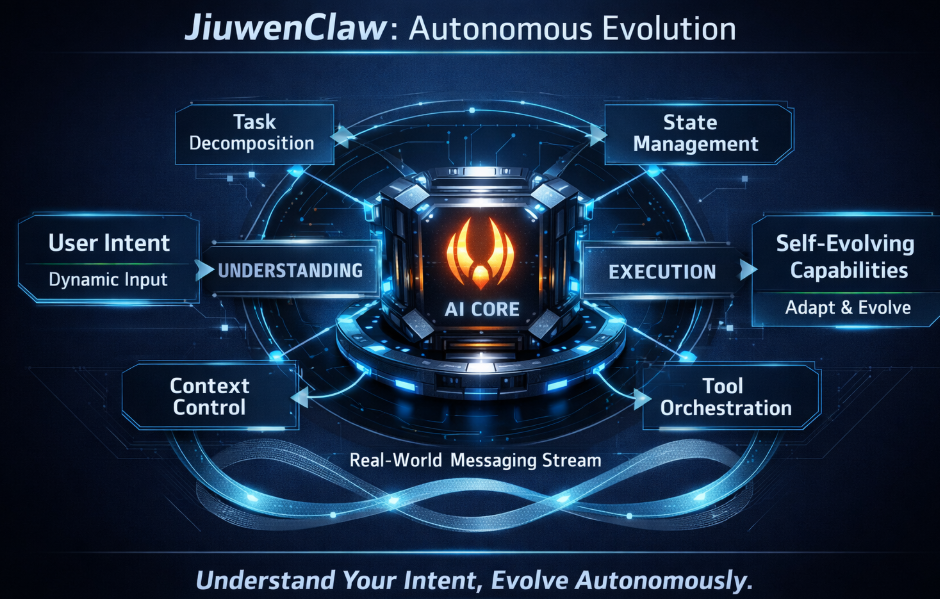
Autonomous Skill Evolution: Powered by the openJiuwen Self-Evolution Framework, JiuwenClaw automatically refines its Skills. If a tool call fails or when the user gives a negative response (eg, “That’s wrong,” or “Try a different method”), the system continuously logs an initialization error and response. It then performs root cause analysis (RCA) to generate targeted improvement strategies.
In short, JiuwenClaw establishes a highly reliable Continuous Learning Loop: Do → Fail → Learn → Improve → Repeat
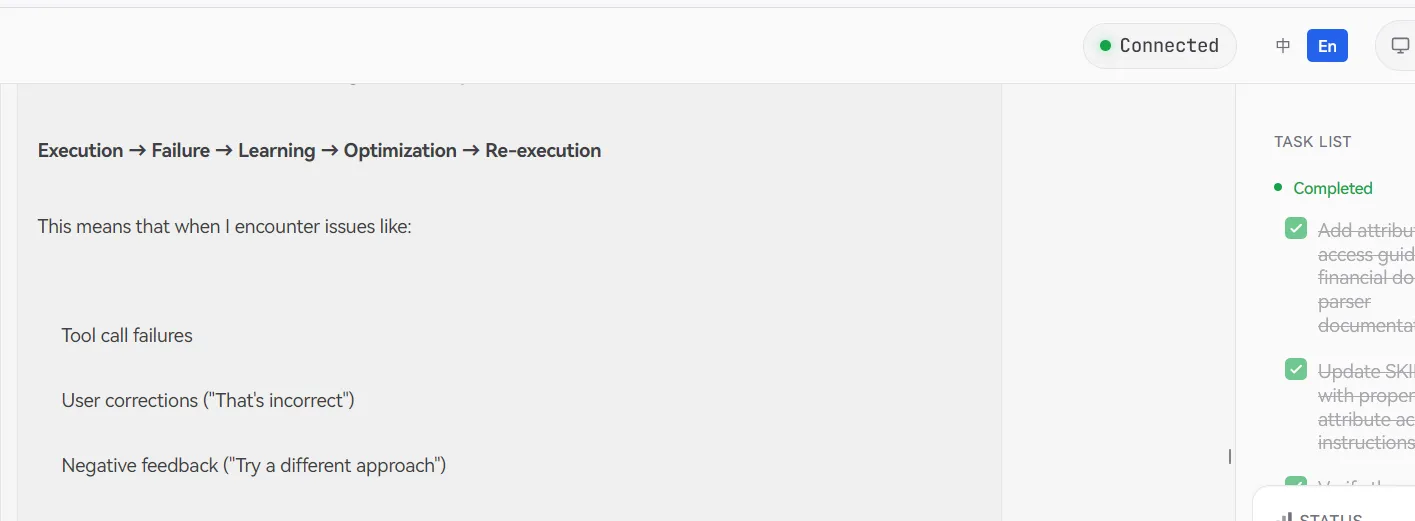
This paradigm shift means that an agent is no longer a static set of tools, but a dynamic system that grows in alignment with the user’s intent in every interaction.
III. Integration into Everyday Workflows: AI Agents Entering the Real World
The key hurdle for most agents is not raw power, but accessibility within native user scenarios. Most agents remain isolated silos, isolated from where the real work takes place.
JiuwenClaw solves this problem with the design of key structures:
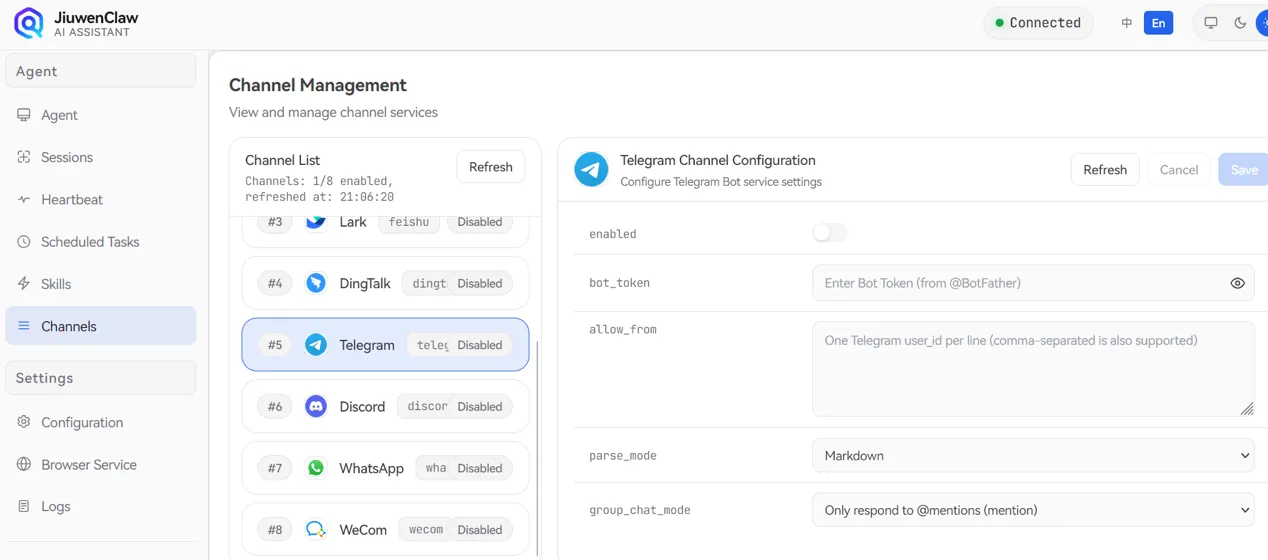
- Seamless Access to Multiple Channels: It natively supports Huawei Celia (Xiao Yi), Telegram, WhatsApp, Feishu (Lark), and Web. This allows users to activate their dedicated AI assistant from any location.
- Data sovereignty: By supporting Private Transmission, it eliminates concerns about data privacy and cross-border data flow, ensuring conflict-free business acquisition.
This design changes the paradigm: the agent is no longer a place you visit (like a standalone website), but a persistent layer embedded within daily communication and professional workflows.
IV. JiuwenClaw Is More Than Just An Agent
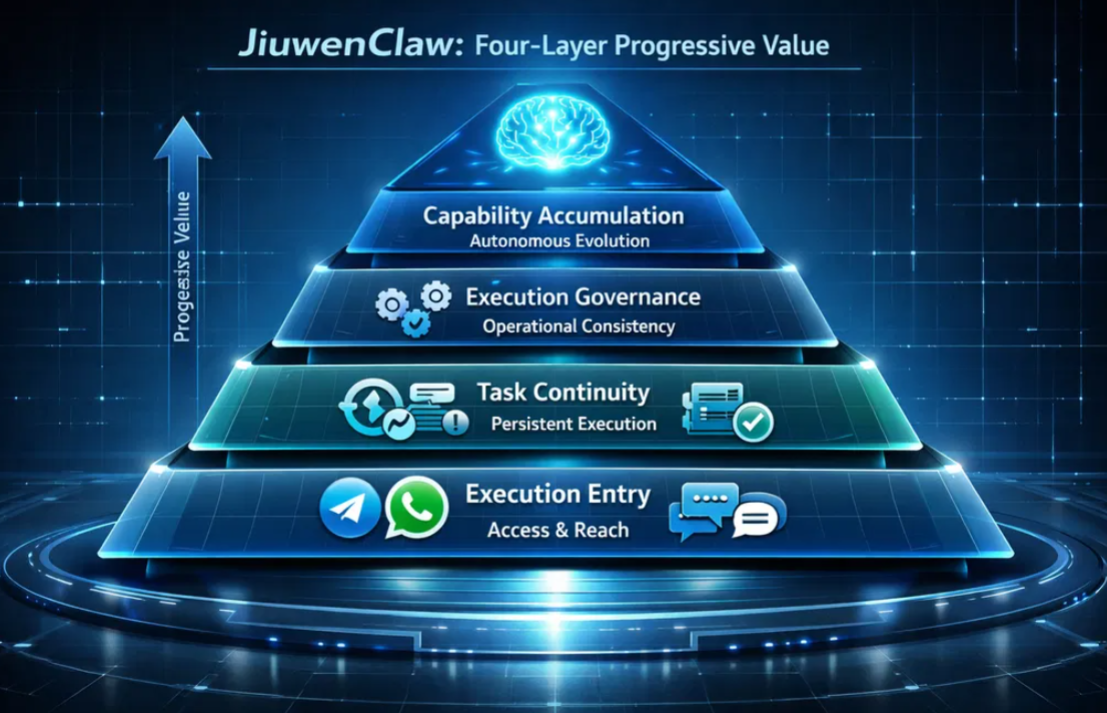
When we combine these skills, a clear Architectural Hierarchy emerges. The JiuwenClaw is not just a monolithic tool; is a multi-layered rendering engine:
| Background | JiuwenClaw solution |
| Entry level | Cross-platform access for real-world use cases. |
| The Implementation Framework | Scheduling work to ensure continuity of work flow. |
| Layer of Durability | Content management + Memory system for long-running tasks. |
| The Evolution Layer | Automatic evolution for creativity with every use. |
The convergence of these four layers represents a fundamental shift: AI agents are moving from “conversation-based systems” to “high-fidelity execution systems.”
V. The Industrial Shift: From “Chat-Centric” to “Execution-Centric” AI
For the past two years, the field of AI has been dominated by the “Turing Test”: Who is smarter? Who sounds human? Who scores high in LLM benchmarks? However, we are now seeing a Paradigm Shift where the main metric is no longer the manner of speaking, but the Task Completion Rate. JiuwenClaw’s architecture marks the transition to process-aware intelligence:
- Apart from the Cognitive Problem: It internalizes the entire Task Lifecycle, recognizing that purpose is dynamic, not static.
- The answer is from Generation: Maintains Execution Momentum, ensuring that the agent is not just “talking” about a solution but actively driving the workflow to completion.
- Without a Tool Call: It focuses on environmental effects, operating within messy, inappropriate real-world systems rather than clean sandboxes.
The conclusion: Entering the Era of the Trustworthy Executor
The next frontier of competition for AI agents has officially passed the “Chatbot” era. We are entering the era of the reliable executor.
JiuwenClaw is not just a collection of features; it’s special, Production-Grade Architecture built for:
- Sustainability: Long-lasting activities that do not deteriorate over time.
- Adaptability: Resiliency in the face of changing user needs.
- Evolution: A self-developing skill set that reduces manual dexterity.
If this trend holds, the agents that survive the next wave of AI adoption won’t be the most efficient—they’ll be the ones that get the job done.
Join the Community & Explore openJiuwen
openJiuwen Download Links
JiuwenClaw Download Links
Note: “Thanks to the OpenJiuwen team for the thought leadership/resources and for supporting and sponsoring this article.”