Computational Costs of Zero Padding in Convolutional Neural Networks (CNNs)


What is Zero Padding
Zero padding is a technique used in convolutional neural networks where extra pixels with a value of zero are added to the borders of the image. This allows the convolutional characters to slide over the edge pixels and helps control how much the spatial dimension of the feature map is reduced after convolution. Padding is often used to save feature map size and enable deep network structures.

The Hidden Problem With Zero Padding
From a signal processing and statistical point of view, zero padding is not a trivial task. Injecting zeros at image boundaries introduces artificial discontinuities that are not present in the original data. These sharp transitions act as hard edges, causing convolutional filters to respond to padding instead of meaningful image content. As a result, the model learns different statistics at the borders than at the center, subtly breaking translational symmetry and activating the tilt feature near the edges of the image.
How Zero Padding Changes Feature Performance
Setting dependencies
pip install numpy matplotlib pillow scipyimport numpy as np
import matplotlib.pyplot as plt
from PIL import Image
from scipy.ndimage import correlate
from scipy.signal import convolve2dImporting an image
img = Image.open('/content/Gemini_Generated_Image_dtrwyedtrwyedtrw.png').convert('L') # Load as Grayscale
img_array = np.array(img) / 255.0               # Normalize to [0, 1]

plt.imshow(img, cmap="gray")
plt.title("Original Image (No Padding)")
plt.axis("off")
plt.show()
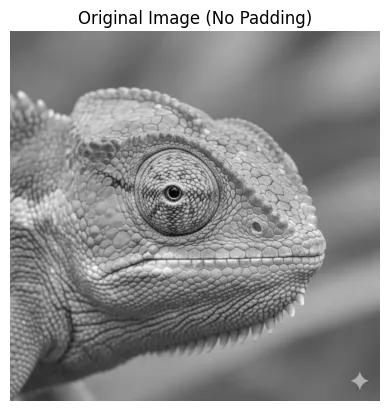
In the above code, we start loading the image from disk using PIL and convert it clearly gray colorsince convolution and edge detection analysis are easier to think about in a single intensity channel. The image is then converted to a NumPy list and normalized to [0,1][0, 1][0,1] width so that pixel values represent meaningful signal magnitudes rather than raw byte intensity. In this experiment, we use the image of a chameleon produced using Nano Banana 3chosen because it is a real, written object well placed within the frame—making any strong responses to the borders of the image clearly caused by padding rather than actual visible edges.
Creating an Image with Zeros
pad_width = 50
padded_img = np.pad(img_array, pad_width, mode="constant", constant_values=0)

plt.imshow(padded_img, cmap="gray")
plt.title("Zero-Padded Image")
plt.axis("off")
plt.show()
In this step, we apply zero padding to the image by adding a border with a fixed width around all sides using NumPy’s pad function. Parameter mode=’constant’ with constant_values=0 implicitly fills the area with zeros, effectively surrounding the original image with a black frame. This work does not add new visual information; instead, it introduces an intensity discontinuity at the boundary between the original pixels and the sharpened pixels.
Using the Edge Detection Kernel
edge_kernel = np.array([[-1, -1, -1],
                        [-1,  8, -1],
                        [-1, -1, -1]])

# Convolve both images
edges_original = correlate(img_array, edge_kernel)
edges_padded = correlate(padded_img, edge_kernel)
Here, we use a simple Laplacian-style edge detection kernel, designed to respond robustly to sudden intensity changes and high-frequency signals such as edges. We use the same kernel for both the original image and the zero-padded image using interpolation. Since the filter remains constant, any difference in the output can be attributed to the padding alone. The strong edge responses near the bounds of the embedded image are not due to real image properties, but to artificial zero-valued boundaries introduced by zero padding.
Visualization of Clip Artifacts and Diffusion Shifts
fig, axes = plt.subplots(2, 2, figsize=(12, 10))

# Show Padded Image
axes[0, 0].imshow(padded_img, cmap='gray')
axes[0, 0].set_title("Zero-Padded Imagen(Artificial 'Frame' added)")

# Show Filter Response (The Step Function Problem)
axes[0, 1].imshow(edges_padded, cmap='magma')
axes[0, 1].set_title("Filter Activationsn(Extreme firing at the artificial border)")

# Show Distribution Shift
axes[1, 0].hist(img_array.ravel(), bins=50, color="blue", alpha=0.6, label="Original")
axes[1, 0].set_title("Original Pixel Distribution")
axes[1, 0].set_xlabel("Intensity")

axes[1, 1].hist(padded_img.ravel(), bins=50, color="red", alpha=0.6, label="Padded")
axes[1, 1].set_title("Padded Pixel Distributionn(Massive spike at 0.0)")
axes[1, 1].set_xlabel("Intensity")

plt.tight_layout()
plt.show()
Of top-leftThe zero image shows a black outline like the one added to the first image of the chameleon. This framework does not come from the data itself—it is an artificial construct introduced for ease of design. Of top rightthe response of the filter on the edge reveals the result: despite the real semantic limit on the border of the image, the filter burns more on the focus border. This happens because the transition from real pixel values to zero creates a sharp step function, which edge detectors are clearly designed to amplify.
I bottom line highlights a deep mathematical issue. The histogram of the original image shows a smooth, natural distribution of pixel intensities. In contrast, the distribution of the stamped image shows a peak intensity of 0.0, which represents pixels with zero value injected. This speaker shows a clear shift in distribution introduced by padding alone.
The conclusion
Zero padding may seem like a harmless architectural choice, but it quietly adds a strong logic to the data. By placing zeros around the actual pixel values, it creates step functions for convolutional filters that interpret as logical edges. Over time, the model begins to associate parameters with certain patterns—introducing local bias and violating the central promise of interpretive equivalence.
More importantly, zero padding changes the statistical distribution at the edges of the image, causing edge pixels to follow a different activation pattern than interior pixels. From a signal processing perspective, this is not a minor detail but a structural distortion.
In production-grade systems, padding techniques such as reflection or iteration are often preferred, as they preserve statistical continuity across boundaries and prevent the model from learning artifacts that were never present in the original data.

I am a Civil Engineering Graduate (2022) from Jamia Millia Islamia, New Delhi, and I am very interested in Data Science, especially Neural Networks and its application in various fields.