
Bitcoin mining difficulty is expected to see a significant drop on Saturday, due to the Hashrate disruption caused by the US snowstorm.
Bitcoin difficulty is estimated to decrease by 13% during the next correction
Bitcoin “Difficulty” is a metric built into the blockchain that governs how hard miners will mine the next block in the network. The value of this indicator changes automatically about every two weeks, based on the speed at which miners have performed their work since the previous correction.
The next such correction is scheduled to take place tomorrow, February 6. According to data from CoinWarz, the network will reduce the difficulty during this event.
The way the blockchain decides whether to increase or decrease the Difficulty is simple: it tries to reset the block time back to the standard 10 minutes that Satoshi coded for the network to follow. Whenever miners produce an average block in a faster time than this, the network responds by raising its Difficulty enough that miners take 10 minutes between each block again. Similarly, validators are slow forcing BTC to simplify the metric.
Since the last update, the average block time has stood at 11.52 minutes, which is much slower than the expected value. Because of this, Bitcoin is estimated to reduce its difficulty by a whopping 13% during Saturday’s correction.
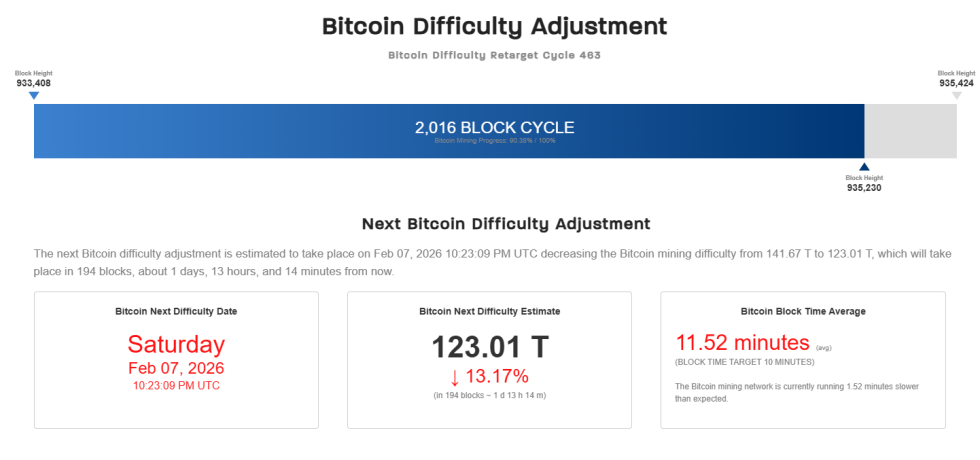
The details related to the upcoming Difficulty adjustment | Source: CoinWarz
The reason for the big change in Difficulty lies in the crash that Bitcoin Hashrate has seen recently. “Hashrate” is an indicator that measures the total amount of computing power of all the miners connected to the network.
As data from Blockchain.com shows, the metric’s 7-day average value has seen a significant drop since January 24th.
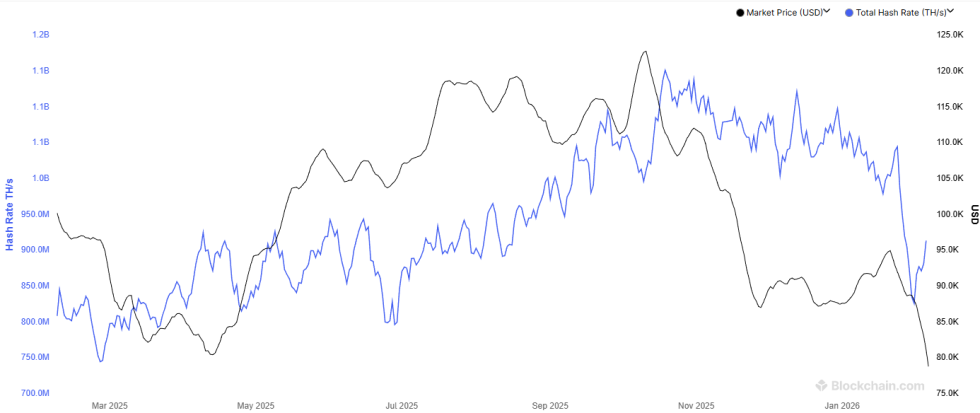
How the BTC mining Hashrate has changed during the past year | Source: Blockchain.com
On January 24th, the 7-day average Bitcoin Hashrate stood at 1,044 exahashes per second (EH/s). By the end of the month, that number had dropped to just 825 EH/s. This was an unusually fast pullback for the index, and indeed there was an unusual cause behind it: the US snowstorm.
This winter storm disrupted the nation’s infrastructure, including electricity. To reduce the pressure on the grid, American Bitcoin miners reduced their electricity consumption, which led to Foundry USA, the largest mining pool in the world, seeing a drop in Hashrate of almost 60%.
In February so far, US miners have started to bounce back, with the global average 7-day Hashrate returning to 913 EH/s. A drop in Hashrate that is only temporary doesn’t mean anything to Difficulty, however, since the network only looks at the average block time from the last two weeks.
The fact that miners produced blocks on a small scale during this window is already set in stone, so the Bitcoin network has no choice but to reduce the Difficulty in the next correction.
BTC price
Bitcoin fell as low as $60,000 on Thursday, but the cryptocurrency has bounced back as it is now trading around $69,300.
The trend in the price of the coin over the last five days | Source: BTCUSDT on TradingView
Featured image from Dall-E, chart from TradingView.com

Planning process because bitcoinist focuses on delivering well-researched, accurate, and unbiased content. We maintain strict sourcing standards, and each page is diligently reviewed by our team of senior technical experts and experienced editors. This process ensures the integrity, relevance, and value of our content to our readers.