Bitcoin Weakness Continues: Stablecoin Supply Signals Risk-Off Environment


Bitcoin remains under selling pressure below the $70,000 level as the market faces renewed uncertainty and weak liquidity conditions. The inability to restore this key psychological barrier has strengthened the tone of caution among investors, with price action reflecting a broader struggle across risk assets. Although volatility remains high, the current environment suggests that market participants are increasingly focusing on liquidity and capital flows rather than only short-term price increases.
Axel Adler’s analysis highlights two key liquidity indicators that point to continued market weakness. The Stablecoin Supply Ratio (SSR) Oscillator has returned to negative territory after a brief positive trend in January, indicating that Bitcoin continues to underperform relative to stablecoin dynamics. Historically, positive SSR readings have been accompanied by strong price appreciation, while sustained negative readings have often accompanied periods of price stagnation or decline.

At the same time, the 30-day change in USDT market capitalization dropped to around $2.87 billion, reflecting the outflow of money from the crypto ecosystem. Together, these indicators suggest that January’s recovery efforts lacked sustained fiscal support. Unless stablecoin inflows return and the SSR oscillator stabilizes in a positive area for several weeks, the broader market context may remain vulnerable, leaving Bitcoin vulnerable to further pressure in the near term.
Stablecoin Liquidity Trends Reinforce Bitcoin Market Weakness
Axel Adler’s analysis emphasizes the importance of stablecoin liquidity as a leading indicator of Bitcoin market conditions. The 30-day change in USDT market capitalization serves as a guiding gauge of dollar liquidity entering or exiting the crypto ecosystem. Positive readings generally indicate new cash inflows that may support price declines, while negative readings indicate a decrease in cash flow and a decrease in risk appetite among market participants.

According to the data, January briefly showed signs of recovery. USDT’s 30-day market capitalization moved in positive territory, reaching around $1.4 billion in the first week of the month. This flow coincided with the Stablecoin Supply Ratio (SSR) Oscillator’s attempt to move into positive territory, which coincided with a short-term Bitcoin price rally. However, the trend reversed later in January, and the latest reading near $2.87 billion confirms renewed outflows.
The alignment between these two indicators appears to be mutual rather than accidental. Liquidity inflows helped support January’s short-term recovery, while the recovery in cash flows coincided with subsequent market weakness.
As long as USDT’s 30-day trend remains negative, a sustained SSR recovery seems unlikely. Together, these signs suggest that the market has shifted into a risk-free zone, reinforcing the view that the recent rally lacks strong financial support.
Bitcoin Remains Under Pressure After Breaking Below Key Values
The daily Bitcoin chart continues to show sustained bearish momentum following the loss of the $70,000 level, and the price is now consolidating in the mid-$60,000 range after a major decline. The recent break below this psychological threshold has been accompanied by a decisive move below the major moving averages, which have changed from support to resistance. This structural change usually indicates weakening bullish control and increasing caution among market participants.
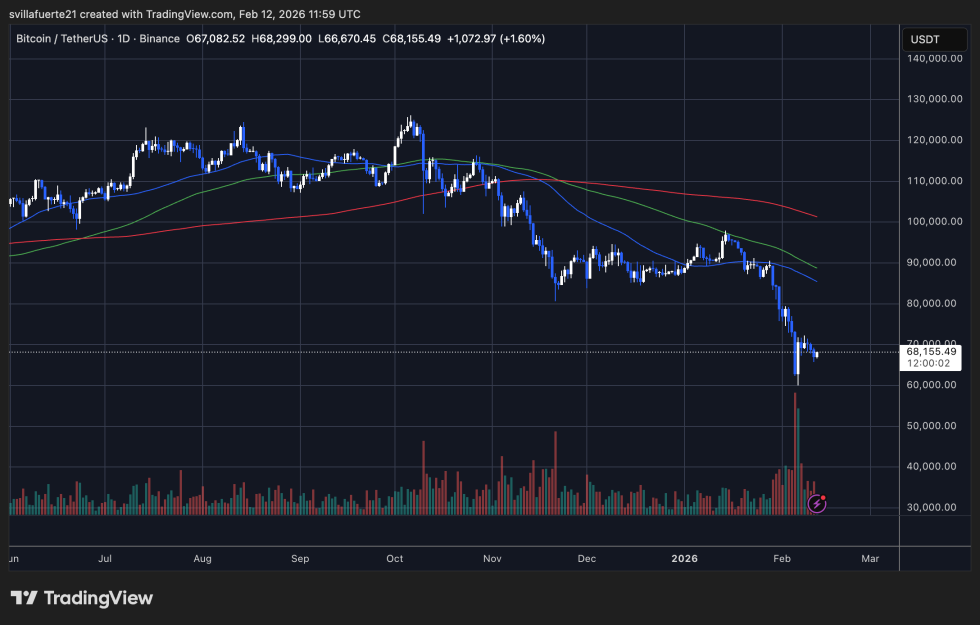
The price action shows a sequence of lower highs from late 2025, suggesting a gradual deterioration of the market structure rather than a single correction. Recent declines have been accompanied by significant increases in trading volume, often associated with forced reductions or hedging repositioning rather than continued accumulation. This volatility can increase short-term volatility while delaying rational recovery efforts.
From a technical perspective, the $60,000–$62,000 region now represents a key support area. This area is consistent with previous consolidation phases and historically strong currency pools that can attract demand. Holding this position will support the stabilization situation, which may lead to the integration of the sides. On the other hand, a decisive break below it could open the door to deeper retracement phases.
Until Bitcoin regains significant moving averages and restores a higher price structure, the market is likely to remain sensitive to liquidity conditions, high sentiment, and derivative positions.
Featured image from ChatGPT, chart from TradingView.com

Planning process because bitcoinist focuses on delivering well-researched, accurate, and unbiased content. We maintain strict sourcing standards, and each page is diligently reviewed by our team of senior technical experts and experienced editors. This process ensures the integrity, relevance, and value of our content to our readers.